Multimode Fiber Guide: OM1–OM5 Compared for Your Setup
Navigating the world of fiber optics can be complex. Multimode fiber is a key player in high-speed data transmission. It’s essential for short-distance communication, often within buildings or campuses. This guide will help you understand the differences between OM1 to OM5 fibers. Each type has unique features and benefits.
Choosing the right fiber can optimize your network’s performance and cost. From OM1’s basic capabilities to OM5’s advanced features, each serves a specific purpose. We’ll explore core sizes, bandwidth, and color codes. This will help you make informed decisions for your setup.
Whether you manage data centers or plan future-proof networks, this guide is your roadmap.
Multimode Fiber Types and Their Differences
Multimode fibers are classified from OM1 to OM5, each offering unique features and benefits. Understanding these distinctions is crucial for selecting the right fiber for your setup.
OM1 Fiber
What It Is: OM1 Fiber has a core diameter of 62.5 micrometers and is designed for short-distance applications. It supports data rates of up to 1 Gbps over distances up to 275 meters. Although it is older and less common in new installations, it’s still used in some legacy systems and other basic applications.
Product Example: For a simple home network setup or older business infrastructure, the Monoprice OM1 Fiber Optic Cable, LC/LC UPC, Duplex Multi-Mode 62.5/125 Type, UL, OFNR, Corning, Orange, 2m, provides reliable performance for shorter distances.
Use Case Example:
• Individual Use: Ideal for home setups where you need to connect multiple devices within a few rooms.
• Business Use: Suitable for older office networks or small-scale installations where high-speed data transfer over short distances is sufficient.
What It Is: OM2 Fiber features a 50 micrometers core and offers improved performance over OM1. It supports data rates of 1 Gbps over 550 meters and 10 Gbps over 82 meters, making it a good choice for newer, short-range installations.
Use Case Example:
• Individual Use: Perfect for a small office or home network requiring reliable, higher-speed connections over short distances.
• Business Use: Ideal for connecting equipment in a data center or office environment where cost-effective, short-range performance is needed.
OM3 Fiber
What It Is: OM3 Fiber, with its 50 micrometers core, is optimized for high-speed data transmission. It supports data rates of 10 Gbps over 300 meters and 40 Gbps over 100 meters, making it suitable for data centers and high-performance computing environments.
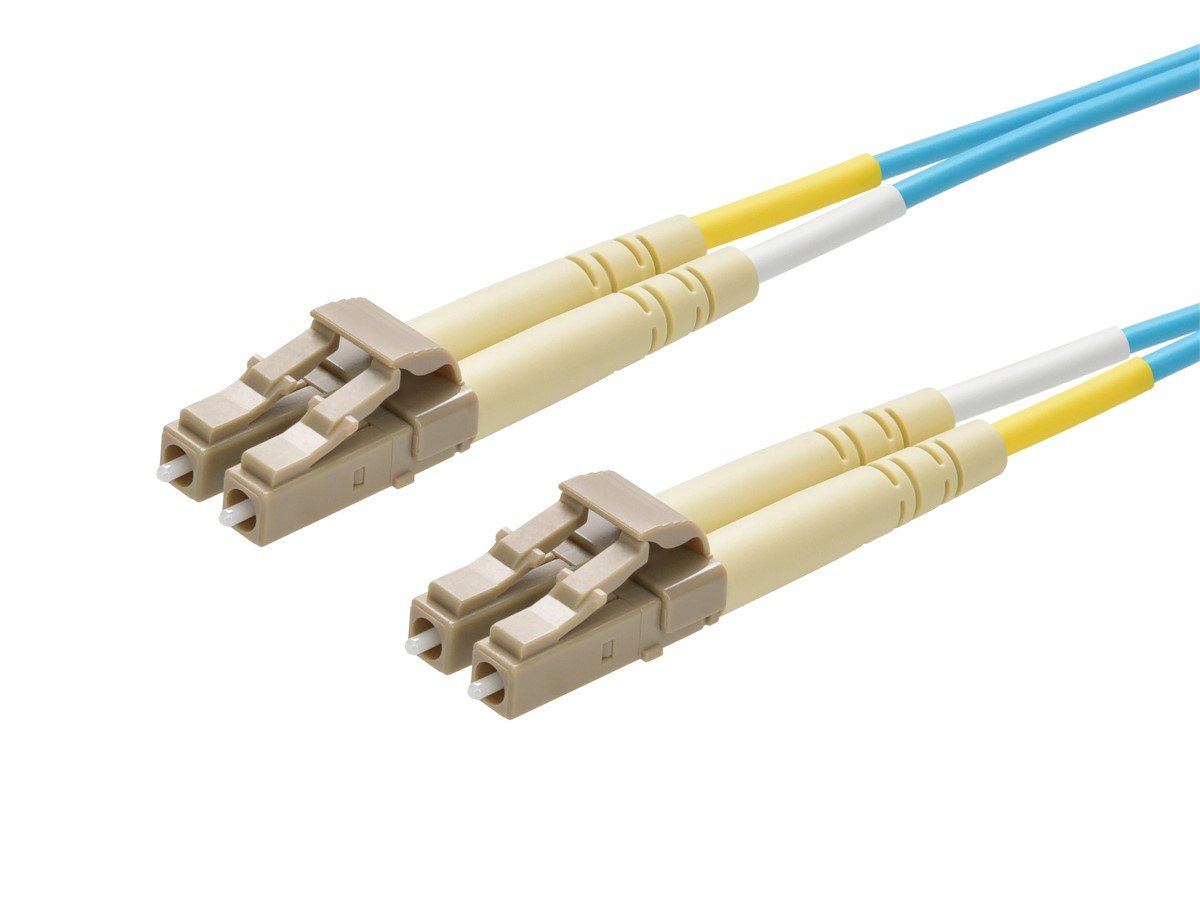
Product Example:For demanding applications, the Monoprice Multi-Mode OM3 Fiber Optic Cable - LC-LC UL 2mm 50/125 OFNR Duplex Aqua 2m, provides the high-speed connectivity required for some modern networks.
Use Case Example:
• Individual Use: Excellent for advanced home networks that handle high-definition streaming, gaming, or large file transfers.
• Business Use: Perfect for data centers or enterprises needing high bandwidth and reliability for critical operations.
What It Is: OM4 Fiber enhances performance further, with a 50 micrometers core supporting data rates of 10 Gbps over 500 meters and 100 Gbps over 150 meters. It’s ideal for future-proofing high-speed network infrastructure.
Product Example: For top-tier performance, the Monoprice Multi-Mode OM4 Fiber Optic Cable - SC-SC UL 3mm 50/125 OFNR Duplex Aqua 2m, offers superior speed and distance capabilities for the most demanding applications.
Use Case Example:
• Individual Use: Great for tech enthusiasts or home offices planning for future needs or running multiple high-speed devices.
• Business Use: Best suited for large-scale modern data centers or enterprises needing high-performance, long-distance fiber connectivity.
What It Is: OM5 Fiber is the newest addition to the Multimode Fiber family, designed for wideband multimode fiber (WBMMF) applications. It supports advanced data rates of 10 Gbps over 550 meters and 100 Gbps over 440 meters, making it ideal for next-generation network demands.
Product Example:For those looking to invest in cutting-edge technology, the Monoprice Multi-Mode OM5 Fiber Optic Cable - LC-LC UL 2mm 50/125 OFNR Duplex Green 1m, offers top-notch performance and future-ready capabilities, providing a reliable solution for high-bandwidth applications.
Use Case Example:
• Individual Use: Future-proofing for upcoming technology trends and high-bandwidth applications.
• Business Use: Perfect for organizations planning for advanced network solutions and high-capacity data transmission.
Each type serves distinct needs based on desired data rates, distances, and budgetary considerations. Understanding these differences aids in optimizing network efficiency and reducing long-term costs.
Core size significantly influences the bandwidth capabilities of each multimode fiber type. Larger core sizes usually denote lower bandwidth capabilities, while smaller cores can handle more data.
OM1 and OM2 fibers differ mostly by their core sizes—62.5 micrometers for OM1 and 50 micrometers for OM2. This difference allows OM2 to support slightly higher speeds and longer distances compared to OM1.
Each fiber type also has a color code:
• OM1 and OM2: Orange
• OM3 and OM4: Aqua
• OM5: Lime Green
These color codes help identify the fiber types easily, ensuring proper installation and maintenance in networks.
Performance and Applications: Which Fiber for Which Use?
Understanding the performance of each fiber type is crucial in determining its ideal application. OM1 and OM2 fibers serve well in legacy systems but are slowly being phased out. They primarily cater to networks requiring lower speeds and shorter distances.
On the other hand, OM3 and OM4 fibers excel in environments demanding higher speeds. OM3 supports 10 Gigabit Ethernet up to 300 meters, while OM4 extends this reach to 550 meters. This makes them suitable for high-performance computing and data-intensive environments.
OM5 fiber is designed for Short Wavelength Division Multiplexing (SWDM), supporting data rates up to 100 Gigabit Ethernet. It is backward compatible with OM3 and OM4, offering seamless integration in existing setups.
Here is a quick application guide:
• OM1: Older networks, short distances
• OM2: Moderate speed requirements
• OM3 and OM4: Data centers, high-performance computing
• OM5: Future-proof setups, high-speed data transmission
Selecting the right multimode fiber is key to optimizing network performance and cost efficiency.
Cost, Compatibility, and Future-Proofing Your Network
When planning your network, understanding the cost and compatibility of fiber types is crucial. OM1 and OM2 fibers offer lower initial costs but may not support future speed demands. Investing in OM3, OM4, or OM5 can be more expensive initially but provides long-term savings.
Compatibility between different fiber types is essential for seamless network upgrades. OM5 is backward compatible with OM3 and OM4, offering flexibility in adapting to future technologies. This makes it a versatile choice when building a future-proof network.
Here are some considerations for future-proof networks:
• Cost vs. Performance: Balance initial costs with long-term value.
• Backward Compatibility: Consider fibers that integrate well with existing infrastructure.
• Investment in Future: Choose fibers that can handle increased data loads.
Choosing the Right Multimode Fiber for Your Setup
Selecting the right multimode fiber involves assessing your specific requirements. Consider the data transmission distance and speed needed for your network. Long-distance, high-speed applications generally benefit from OM3, OM4, or OM5 fibers.
Budget constraints also influence fiber choices. While OM1 and OM2 can be economical, they may fall short on future scalability. Investing in higher-grade fibers like OM5 may offer better long-term performance.
To help with your decision, evaluate the following factors:
• Distance Requirements: Match fiber type to your coverage needs.
• Budget Constraints: Balance cost with network demands.
• Scalability: Opt for fibers that support future growth.
Installation and Maintenance Tips for Fiber Optic Cables
Proper installation is key for optimal fiber optic performance. Keep cables free from kinks or stress to prevent signal loss. Ensure secure connections to avoid any disruptions in data flow.
Regular maintenance is essential to maintain fiber health. Inspect cables periodically for signs of wear or damage. Schedule routine cleanings to remove dust and debris that can impair signal quality.
Consider the following practices:
• Cable Management: Organize and label for easy identification.
• Stress Relief: Use bend radius to prevent cable stress.
• Monitoring Tools: Employ diagnostics to detect issues early.
Why Choose Monoprice Fiber Optic Cables?
Looking for reliable fiber optic cables that won't let you down? Here’s why Monoprice is your go-to choice:
Corning® Fiber
Our cables feature high-quality Corning® glass fibers, ensuring the best performance for all your networking needs.
Wide Selection
Whether you need cables for personal use or large-scale projects, we have a variety to choose from.
Volume Pricing
Enjoy great savings on wholesale purchases with our competitive volume pricing.
Lifetime Warranty
Every cable comes with a lifetime warranty, giving you peace of mind.
Easy 30-Day Returns
Not completely satisfied? Our hassle-free 30-day return policy has got you covered.
Tech Support
Our expert tech support team is always ready to answer your questions and help you choose the perfect product.
Comprehensive Business Support
Our sales representatives are available via phone or email to assist with custom quotes, and our convenient line of credit can help expand your business procurement.
Trusted Experience
With over 22 years in the business, you can count on Monoprice for quality and reliability.
Wrapping Up: Making the Best Choice for High-Speed Data Transmission
Choosing the right multimode fiber is crucial for your network’s performance. Whether it’s OM1, OM3, or OM5, each type offers unique benefits. Consider your bandwidth needs, distance, and budget when deciding.
Investing in the right fiber ensures your network handles current and future demands. By understanding the characteristics of each multimode fiber, you can optimize for high-speed data transmission effectively. Make sure your decision aligns with long-term objectives for future-proof networks.
Need more help? Check out our Fiber Optic Cable Guide for additional information and support. Click below link!