Fiber Optic Installation Guide: Types, Tips & Best Practices
What Is Fiber Optic Installation and Why Does It Matter for Your Network?
Fiber optic installation is the process of deploying glass or plastic strand-based cabling infrastructure to transmit data using pulses of light rather than electrical signals. It is, without question, one of the most significant advancements in modern networking -- and if you are planning a new build, upgrading an existing facility, or trying to understand what your ISP just ran through your utility conduit, this is worth understanding properly. Fiber is not a niche solution anymore. It is rapidly becoming the standard backbone for enterprise networks, data centers, commercial properties, and increasingly, residential deployments. The way data moves across these strands -- at near-light speeds, over considerable distances, with minimal signal degradation -- fundamentally changes what is possible in a connected environment.
How Fiber Optic Cabling Actually Works
Here is the core concept, simplified: traditional copper cable carries electrical current to represent data. Fiber optic cable carries light. A transmitter converts electrical signals into light pulses, those pulses travel down the fiber strand, and a receiver on the other end converts them back. The fiber itself -- typically made from ultra-pure silica glass -- is surrounded by a cladding layer that reflects light inward, keeping the signal contained and moving forward. That mechanism is called total internal reflection, and it is what makes fiber so efficient over long runs. There are two primary types in use: single-mode fiber, which uses a narrow core and a single light path for very long-distance, high-bandwidth transmission, and multimode fiber, which uses a wider core and is better suited for shorter distances like within a building or campus environment. Knowing which type fits your application is one of the first real decisions in any fiber installation project.
Single-Mode vs. Multimode Fiber: Choosing the Right Type
The distinction between single-mode and multimode fiber comes down to distance, bandwidth requirements, and cost. Single-mode fiber supports transmission distances of up to 40 kilometers or more -- sometimes significantly further with the right transceivers -- and is the preferred choice for carrier networks, long-haul telecom runs, and inter-building campus links. Multimode fiber is more practical and cost-effective for intra-building runs, data center interconnects, and enterprise backbone cabling where distances stay under roughly 550 meters depending on the grade. Multimode fiber categories -- OM1, OM2, OM3, OM4, and OM5 -- represent progressively higher bandwidth capacities and optimized wavelength support. OM3 and OM4 remain the most common in active deployments today, while OM5 is gaining traction in environments requiring wavelength-division multiplexing. Choosing incorrectly adds cost, reduces performance, and can require a full infrastructure redo down the line.
Key Steps in a Fiber Optic Installation
A proper fiber installation follows a defined sequence. Rushing any phase creates problems that are difficult and expensive to correct after the fact. Here is a general overview of what a professional installation typically involves:
- Planning and site survey to assess conduit paths, distance requirements, bend radius limitations, and environmental conditions
- Cable pulling or blowing through conduit -- fiber is fragile under tension and requires careful handling
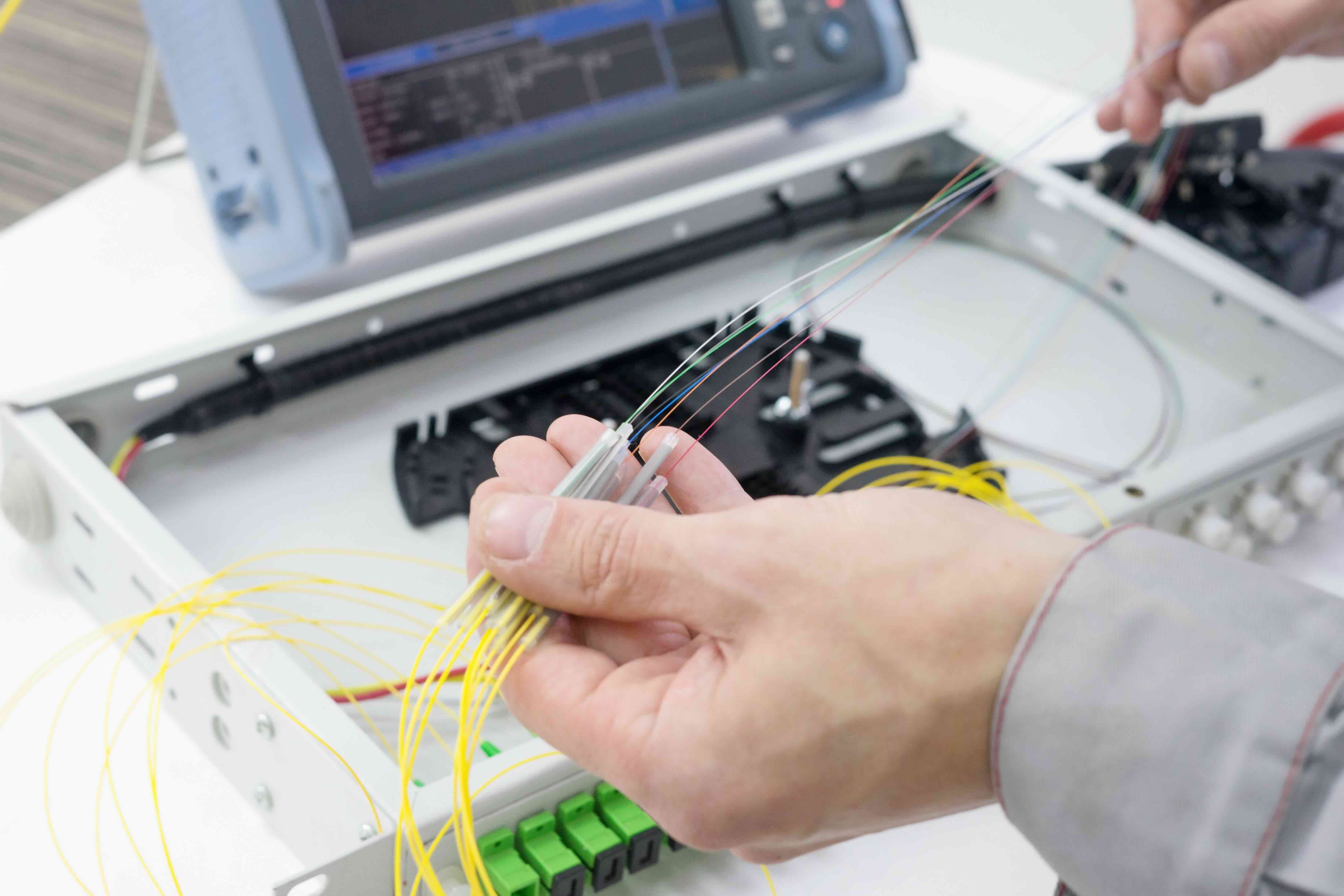
- Termination, either by field polishing connectors or using pre-terminated assemblies with fusion-spliced pigtails
- Fusion splicing for runs that require joined segments, using a fusion splicer to permanently weld fiber ends together
- OTDR testing and insertion loss measurement to verify signal quality, splice performance, and overall link integrity
- Documentation of all runs, connector types, labeling, and test results for ongoing maintenance reference
Each phase has its own set of tools, techniques, and tolerances. Installation quality directly determines long-term performance, so this is not an area where cutting corners makes sense.
The Real Advantages of Fiber Over Copper
Fiber offers a performance profile that copper simply cannot match in demanding environments. Bandwidth capacity is the obvious headline -- fiber supports 10G, 40G, 100G, and even 400G transmission without breaking a sweat, depending on the hardware. But the advantages extend beyond raw speed. Fiber is immune to electromagnetic interference, which is a significant issue in industrial environments, electrical rooms, and any space with heavy machinery or high-voltage equipment running nearby. It does not corrode, it is not susceptible to ground loops, and it does not carry electrical current -- which makes it inherently safer and better suited for inter-building runs where grounding differences between structures would otherwise cause problems. Signal attenuation over distance is dramatically lower than copper, which matters enormously in large campuses, warehouses, and multi-floor commercial buildings. Long story short -- if your infrastructure needs to scale, fiber is the architecture that supports that growth without forcing a complete overhaul every few years.
Common Challenges and Drawbacks to Know Before You Start
Fiber is not without its complications. The installation requires more specialized skill than copper cabling. Terminating fiber connectors properly -- whether through field polishing or fusion splicing -- demands trained technicians and calibrated equipment. Fiber strands themselves are fragile; minimum bend radius violations during pulls can create micro-fractures that degrade signal quality in ways that are not immediately visible. Troubleshooting those issues later requires an OTDR, which is a specialized piece of test equipment with a significant price tag. Upfront material and labor costs also tend to run higher than equivalent copper installations, particularly for single-mode deployments requiring precision-grade components. That said, the total cost of ownership over a 10 to 15 year horizon typically favors fiber, especially when factoring in reduced maintenance, longer upgrade cycles, and the ability to support higher bandwidth tiers without replacing the physical plant.
Fiber Installation for Enterprise and Data Center Environments
In enterprise and data center applications, fiber is not optional -- it is the infrastructure expectation. High-density fiber patch panels, structured cabling systems with pre-terminated trunk cables, and MTP or MPO connector arrays are standard in any modern data center design. Fiber supports the spine-leaf architectures that power today's hyperscale compute environments, and it enables the low-latency, high-throughput interconnects that storage area networks and virtualized compute clusters demand. For enterprise campuses, a fiber backbone connecting IDF closets to the MDF provides the headroom to support next-generation switching without rewiring. Getting the fiber infrastructure right at the planning stage -- specifying the right fiber grade, connector type, and port density -- saves significant time and money when it comes time to upgrade active electronics.
Practical Tips for Planning Your Fiber Deployment
Before committing to a fiber installation, a few planning considerations will dramatically improve outcomes. Always overspec conduit fill capacity -- future pulls are far easier if you leave room now. Choose pre-terminated fiber assemblies where possible to reduce field termination variables and speed up installation timelines. Verify transceiver compatibility with your switching hardware before finalizing fiber type, since single-mode and multimode require different optics. Plan for slack storage at each termination point to allow for future re-terminations if connectors become damaged. And document everything -- fiber runs that are not labeled and tested properly become expensive mysteries the moment something degrades or fails.
Why Monoprice Is the Right Partner for Your Fiber Infrastructure Needs
When you are speccing a fiber installation -- whether it is a single rack, a full data center, or a campus backbone -- the quality and consistency of your passive components matter more than most people realize. Connector end-face quality, insertion loss performance, cable construction, and jacket ratings directly affect how well your active equipment performs over the long run. Monoprice has spent years building a reputation as a trusted source for high-performance fiber optic cabling, patch cables, adapters, enclosures, and accessories -- all engineered to meet real-world installation demands without an inflated price tag. From OM3 and OM4 multimode assemblies to single-mode OS2 patch cords and high-density fiber panels, the catalog is built to support professional deployments at every scale. If you are ready to build or upgrade your fiber infrastructure with components that deliver consistent performance at a price that makes sense, explore everything available through Monoprice fiber optic cables and networking infrastructure solutions and see why integrators and IT professionals keep coming back.
Frequently Asked Questions About Fiber Optic Installation
What is the difference between single-mode and multimode fiber optic cable?
Single-mode fiber uses a smaller core diameter and transmits light along a single path, making it ideal for long-distance runs exceeding several kilometers. Multimode fiber uses a larger core that supports multiple light paths simultaneously and is better suited for shorter runs within buildings or campuses, typically up to 550 meters depending on the cable grade.
How long does a fiber optic installation typically take?
Installation time varies significantly based on the scale of the project. A simple in-building run between two network closets might take a day or two. A large enterprise campus or data center fiber deployment can take several weeks when accounting for conduit work, pulling, termination, splicing, and testing.
Can I install fiber optic cabling myself or do I need a professional?
Basic fiber patching and panel work can be performed by experienced IT staff. However, field termination, fusion splicing, and full structured cabling installations require specialized tools, training, and test equipment. Incorrect terminations or improper handling during pulls can cause signal loss that is difficult to detect without proper testing gear.
What tools are required for fiber optic installation?
A complete fiber installation toolkit includes a fusion splicer or field termination kit, cleaver, fiber strippers, optical power meter, light source, and an OTDR for comprehensive link testing. Pre-terminated assemblies can reduce the need for field termination tools on shorter, more straightforward runs.
What does insertion loss mean in fiber optics?
Insertion loss refers to the reduction in optical signal power that occurs as light passes through connectors, splices, and cable segments. It is measured in decibels and is a key indicator of link quality. Lower insertion loss values indicate better performance. Industry standards define acceptable thresholds depending on the connector type and application.
Is fiber optic cabling better than Cat6 or Cat6A for enterprise networking?
Fiber is generally preferred for backbone and long-distance runs due to its higher bandwidth capacity, immunity to electromagnetic interference, and lower signal attenuation over distance. Cat6 and Cat6A remain practical and cost-effective for horizontal runs to endpoints like workstations and IP phones, where distances are under 100 meters.
What is an OTDR and why is it used in fiber testing?
An Optical Time Domain Reflectometer is a diagnostic instrument used to analyze the characteristics of a fiber optic link. It sends pulses of light down the fiber and measures the time and intensity of reflections to identify splice points, connector locations, bends, breaks, and areas of signal loss along the entire length of the run.
What is the typical lifespan of a fiber optic cable installation?
A properly installed fiber optic infrastructure can last 25 to 30 years or more. Because the passive fiber plant does not need to be replaced when upgrading active electronics, the long-term cost of ownership is often significantly lower than copper alternatives, which may require full recabling to support higher bandwidth standards.
What connector types are most commonly used in fiber optic installations?
LC and SC connectors are the most widely deployed in enterprise and data center environments. LC connectors are compact and commonly used in high-density patch panels and SFP transceivers. SC connectors are slightly larger and often found in telecom and older enterprise equipment. MPO and MTP connectors are used for high-density trunk cable systems in data centers.
Does fiber optic cable require grounding or special electrical precautions?
Standard optical fiber does not carry electrical current, so it does not require grounding in the same way copper cabling does. However, some armored or hybrid fiber cables that include metallic components may require grounding per applicable electrical codes. Always review the specific cable construction and consult local electrical standards for your installation environment.